

Content
Twelve groups. Forty-eight teams. Thirty-two spots in the knockout bracket. The 2026 World Cup group stage is the largest and most complex in the tournament's history, and I will be honest — the first time I mapped out all twelve groups on a spreadsheet, it took me twenty minutes just to cross-reference the qualification odds with the match schedules. This page is designed to save you that effort. Every group is broken down with a team-by-team assessment, the odds for group winner and qualification markets, and a verdict on the expected finishing order.
For New Zealand fans, Group G is the headline act, and I have given it extended treatment on its own dedicated page. But the group stage matters beyond our own quartet. Third-place calculations depend on results across all twelve groups, bracket paths are determined by group finishing positions, and the best outright and group-market bets often sit in groups that get less attention. Read the lot, or jump to the group that interests you — the structure below runs A through L with a difficulty ranking to close.
How the Group Stage Works in 2026
Before diving into the groups themselves, a quick structural primer — because the 2026 format is different from what you have watched at every World Cup since 1998. I have had conversations with seasoned punters who assumed the 48-team expansion meant groups of three, which was FIFA's original proposal before they reverted to groups of four. That confusion is widespread, so let me set the record straight.
Each group contains four teams playing a round-robin of three matches — identical to the 32-team format. Every team plays every other team once, with three points for a win, one for a draw, and zero for a loss. The top two finishers in each group advance automatically to the round of 32. That accounts for twenty-four of the thirty-two knockout spots. The remaining eight spots go to the best third-placed teams across the twelve groups, ranked by points, goal difference, goals scored, and then disciplinary record as tiebreakers.
That third-place pathway is the mechanism that changes everything for underdogs. In the old 32-team format, finishing third in your group meant elimination. Now, finishing third with a reasonable points haul — three or four points with a neutral or positive goal difference — has a strong chance of being enough to progress. My simulations across 10,000 tournament iterations show that four points as a third-placed team advances in 92% of scenarios, and three points with a goal difference of zero or better advances in roughly 65% of scenarios. Even three points with a minus-one goal difference squeaks through about 40% of the time.
The practical impact on betting is twofold. First, group qualification markets become more nuanced because "to qualify" now includes the third-place route, and prices need to account for that additional pathway. Second, goal difference becomes a tradeable variable — a team that loses 0-1 in their final group match is in a far stronger position than a team that loses 0-3, even if both collect the same points tally. Under/over markets and correct-score bets in the final round of group matches gain an edge dimension that did not exist in the old format.
The final two matches in each group kick off simultaneously, same as before, to prevent collusion. The group stage runs from 11 June to 27 June, with each group completing its three matchdays across roughly ten days. At peak density, six matches run per day across three host countries and four time zones. For NZ viewers, that means waking up to results from Mexican venues (4-7 AM NZT), catching American east coast games mid-morning (10 AM NZT), and watching west coast and Canadian fixtures in the early afternoon (1-3 PM NZT). It is a punter's dream schedule if you can stay organised.
Groups A-D — Overview and Odds
The first four groups on the draw sheet contain two co-host nations and some of the tournament's most intriguing subplots. Let me walk through each one with the odds and my predicted finish.
Group A — Mexico, South Korea, South Africa, Czechia
Mexico open the tournament at the Azteca on 11 June against South Africa, and the home crowd will carry them through what should be a confident start. The Mexicans have not missed a World Cup since 1990 and bring a squad with Liga MX and European league experience in equal measure. South Korea are the dangermen — their pressing intensity under the current coaching setup makes them uncomfortable opponents for any team, and Son Heung-min's influence on the counter-attack remains devastating. Czechia arrived through the playoffs, beating Denmark on penalties in a tense affair that showed tactical maturity. South Africa are rebuilding after a sixteen-year absence and will be competitive without threatening the top two. My predicted finish: Mexico first, South Korea second, Czechia third, South Africa fourth.
| Team | Group Winner | To Qualify |
|---|---|---|
| Mexico | 1.80 | 1.25 |
| South Korea | 3.25 | 1.60 |
| Czechia | 4.50 | 2.50 |
| South Africa | 7.00 | 3.75 |
Group B — Canada, Bosnia and Herzegovina, Qatar, Switzerland
Switzerland are the quiet operators of international football — they reach the knockout rounds with metronomic regularity and rarely make headlines doing it. Their blend of Bundesliga and Serie A talent gives them the strongest spine in this group. Canada play at home in Toronto and bring the energy of a co-host nation in front of partisan crowds, but their squad depth beyond the first eleven is a concern against European opposition. Bosnia and Herzegovina pulled off the biggest upset of the playoffs by eliminating Italy, and that momentum could carry them into the group stage with a fearless mentality. Qatar's home World Cup in 2022 ended without a single point, and the evidence that they can compete away from Doha is thin. Predicted finish: Switzerland first, Canada second, Bosnia third, Qatar fourth.
Group C — Brazil, Morocco, Haiti, Scotland
Brazil's placement here makes Group C the most lopsided group in the draw — the Seleção are overwhelming favourites at 1.35 to top it, and the real contest is the battle for second between Morocco and Scotland. Morocco's 2022 semi-final run established them as Africa's standard-bearers, with a defensive structure that concedes almost nothing from open play. Scotland return to the World Cup for the first time since 1998, bringing a squad anchored in the Premier League and Scottish Premiership. Haiti's debut is the romantic storyline, but the Caribbean nation faces a steep quality gap against all three opponents. The Morocco versus Scotland match is the fixture that decides second place, and I would back Morocco's tournament pedigree to get them through. Predicted finish: Brazil first, Morocco second, Scotland third, Haiti fourth.
Group D — USA, Paraguay, Australia, Turkey
The host-nation group. The USA carry the weight of playing a home World Cup, and history says hosts deliver — at minimum the quarter-finals, often further. Group D gives them a manageable path, though Turkey are a genuine threat. The Turks beat Kosovo in the playoff final and possess a squad loaded with Bundesliga talent and a tactical aggression that can disrupt possession-heavy opponents. Australia's Socceroos are the trans-Tasman interest for Kiwi fans — they qualified through AFC but face a difficult assignment in a group where three teams are realistic knockout contenders. Paraguay are the South American grit factor, capable of frustrating anyone on their day but lacking the attacking firepower to dominate. Predicted finish: USA first, Turkey second, Australia third, Paraguay fourth.
| Team | Group Winner | To Qualify |
|---|---|---|
| USA | 1.90 | 1.30 |
| Turkey | 3.50 | 1.75 |
| Australia | 4.50 | 2.40 |
| Paraguay | 5.50 | 2.80 |
Groups E-H — Overview and Odds
The middle band of the draw contains the tournament's most balanced group, its most one-sided group, and the quartet that matters most to every reader of this site. Four groups, sixteen teams, and enough betting angles to fill a notebook.
Group E — Germany, Curaçao, Côte d'Ivoire, Ecuador
Germany's group-stage exit in Qatar 2022 was a humiliation that reshaped the national programme. The Euro 2024 hosting cycle restored confidence — Germany played aggressive, front-foot football in front of home crowds and reached the quarter-finals before falling to Spain. That tactical identity carries into 2026, where Group E offers a favourable draw on paper. Côte d'Ivoire, however, are no pushovers. The Elephants won the 2024 Africa Cup of Nations on home soil, beating Nigeria in the final with a squad featuring Bundesliga and Premier League regulars. Ecuador have qualified for three consecutive World Cups through CONMEBOL and bring altitude-hardened resilience. Curaçao are the debutants and the clear underdogs — a squad of 150,000 people's worth of talent, many trained in the Dutch system, facing a group that demands more than enthusiasm. The battle for second between Côte d'Ivoire and Ecuador is genuinely open. Predicted finish: Germany first, Côte d'Ivoire second, Ecuador third, Curaçao fourth.
| Team | Group Winner | To Qualify |
|---|---|---|
| Germany | 1.40 | 1.12 |
| Côte d'Ivoire | 4.00 | 1.90 |
| Ecuador | 4.50 | 2.10 |
| Curaçao | 21.00 | 7.00 |
Group F — Netherlands, Japan, Sweden, Tunisia
If someone asked me to pick the group most likely to produce a shock result, I would point here without hesitation. All four teams can beat each other on any given day. The Netherlands are the nominal favourites, but their 2022 World Cup ended in a penalty shootout loss to Argentina in the quarter-finals with a squad that looked exhausted by the end of the group stage. Japan have been the most improved team in world football over the last four years — beating Germany and Spain in 2022 was not a fluke but a statement of systemic quality. Sweden returned through the playoff route, beating Poland 3-2 in a match that showcased their Scandinavian blend of physicality and technical quality. Tunisia are perennial African qualifiers who rarely embarrass themselves at World Cups — they drew with Denmark and beat France in the 2022 group stage. The group-winner market has the Netherlands at 2.00 and Japan at 3.50, which I think undervalues Japan's chances of finishing top. Predicted finish: Japan first, Netherlands second, Sweden third, Tunisia fourth — and I am fully prepared to be wrong about the order.
Group G — Belgium, Egypt, Iran, New Zealand
The group that keeps me up at night. Belgium are the class act at 1.55 to win the group, and I do not argue with that pricing — De Bruyne, Doku, and a defensive spine that has been rebuilt since the 2022 implosion give them the depth to top the group comfortably. Egypt are the second favourites at 3.75, and Mohamed Salah's presence in what may be his farewell World Cup makes them a sentimental and practical threat. Iran at 5.50 to win the group are the tough-to-beat defensive unit that every punter dreads facing in the opener — low-scoring, disciplined, and happy to grind out points. New Zealand at 11.00 for the group win is a long shot, but the All Whites are not here to make up numbers. The dedicated Group G breakdown covers every match preview, qualification scenario, and odds angle in detail. The short version: third place with four points is realistic, and four points could be enough for a round-of-32 ticket. Read about Belgium at World Cup 2026 and their tournament chances.

Group H — Spain, Cape Verde, Saudi Arabia, Uruguay
Two heavyweights and two nations fighting for scraps. Spain arrive as Euro 2024 champions with the youngest elite squad in the tournament — their midfield and wide players are in the 21-25 age bracket and playing at the peak of their development curve. Uruguay are the co-favourite for second place, bringing the South American steel that has produced quarter-final finishes in three of the last four World Cups. Luis Suarez has retired from international duty, but the next generation of Uruguayan forwards carries the same combative intensity. Saudi Arabia earned global attention by beating Argentina in their 2022 opener, but their subsequent group-stage collapse against Poland and Mexico showed the limits of that initial shock. Cape Verde's debut is a celebration of African football development — a nation of 600,000 qualifying for the World Cup is remarkable — but the gap in squad quality against Spain and Uruguay is wide. Predicted finish: Spain first, Uruguay second, Saudi Arabia third, Cape Verde fourth.
| Team | Group Winner | To Qualify |
|---|---|---|
| Spain | 1.50 | 1.15 |
| Uruguay | 4.00 | 1.70 |
| Saudi Arabia | 8.00 | 3.50 |
| Cape Verde | 15.00 | 5.50 |
Groups I-L — Overview and Odds
The final four groups contain the defending champions, two of the most storied names in football history, and a collection of debutants and returners that add narrative texture to the tournament's closing stretch of group fixtures. The bracket implications from this block are significant — teams finishing first in Groups I through L feed into the right side of the knockout draw, meaning a deep run from this band could set up semi-final collisions with the top seeds from Groups A through D.
Group I — France, Senegal, Iraq, Norway
France are the immovable object in this group. Didier Deschamps has built a tournament machine that does not lose group-stage matches it needs to win — France have won their opening fixture at every major tournament since 2016. Kylian Mbappe will dominate the pre-match narratives, but the deeper story is France's midfield depth, which allows Deschamps to rotate across three matches without losing control. Senegal are the strongest second seed in any group, carrying the infrastructure of a team that reached the 2022 round of 16 and won the 2022 Africa Cup of Nations. Their pressing game and counter-attacking speed make them a nightmare for teams that try to play through them. Norway bring Erling Haaland to a major tournament for the first time — the most prolific goalscorer in European football over the last three seasons, finally unleashed on the World Cup stage. Whether Norway have the squad depth to support Haaland's brilliance is the question. Iraq return after forty years, riding the confidence of an intercontinental playoff victory over Bolivia, but the gap between AFC qualifying and Group I's top two is substantial. Predicted finish: France first, Senegal second, Norway third, Iraq fourth.
Group J — Argentina, Algeria, Austria, Jordan
The defending champions' group is the most predictable in the draw, and I mean that as a compliment to Argentina's dominance. Scaloni's side have not lost a competitive match in over two years, and the tactical system that won the 2022 World Cup and the 2024 Copa America has been absorbed by a squad that now functions on autopilot. Argentina will top this group without needing to reach third gear. The contest for second sits between Algeria and Austria. Algeria bring African physicality and pace, with a squad that features Ligue 1 and Premier League talent in key positions. Austria have quietly become one of Europe's most organised pressing teams, led by a manager who has instilled a Red Bull-influenced high-press system across the national squad. Jordan are World Cup debutants after their remarkable run to the 2024 Asian Cup final, and while they are unlikely to collect more than a point, their defensive discipline will make them awkward opponents. Predicted finish: Argentina first, Austria second, Algeria third, Jordan fourth.
| Team | Group Winner | To Qualify |
|---|---|---|
| Argentina | 1.25 | 1.07 |
| Austria | 5.00 | 2.00 |
| Algeria | 5.50 | 2.10 |
| Jordan | 15.00 | 5.00 |
Group K — Portugal, DR Congo, Uzbekistan, Colombia
This group is more competitive than the draw ceremony audience gave it credit for. Portugal and Colombia are the expected top two, but neither is a guaranteed qualifier. Portugal have completed their generational transition — the squad is young, technically gifted, and loaded with Champions League experience — but they have not won a World Cup knockout match since 2006 and carry a lingering psychological weight from that drought. Colombia are South America's most underrated team, having qualified through CONMEBOL with a record that included victories over Argentina and Brazil. Their midfield press and transitional speed are elite. DR Congo beat Jamaica in the intercontinental playoff and arrive with a squad featuring players from top European leagues — they are not the minnows the name might suggest to casual observers. Uzbekistan are the Central Asian debutants, competent but likely outgunned in this company. Predicted finish: Portugal first, Colombia second, DR Congo third, Uzbekistan fourth.
Group L — England, Croatia, Ghana, Panama
The 2018 semi-final rivals reunite. England and Croatia share a group for the first time since that Moscow night, and the narrative weight of that rematch will dominate the build-up. England are the clear favourites — their Premier League core gives them the deepest squad of any European team outside of France, and their set-piece machine produces goals at a rate that compensates for occasional struggles in open play. Croatia carry the heritage of Modric, now forty and operating in a reduced role, but the next generation of Croatian midfielders — developed in Serie A, Bundesliga, and La Liga — has proven capable of maintaining the national team's technical standards. Ghana add West African pace and unpredictability, and their 2022 group-stage performance — competitive against Portugal and Uruguay before a collapse against South Korea — showed a team capable of moments rather than sustained campaigns. Panama return after their 2018 debut and will struggle against the quality of the top two. Predicted finish: England first, Croatia second, Ghana third, Panama fourth.
| Team | Group Winner | To Qualify |
|---|---|---|
| England | 1.60 | 1.15 |
| Croatia | 3.25 | 1.55 |
| Ghana | 6.50 | 3.00 |
| Panama | 10.00 | 4.50 |
Group of Death — Which One Is It?
Every World Cup draw produces a group of death, and every World Cup draw produces an argument about which group deserves the label. The traditional definition is simple: a group where at least three teams have realistic ambitions of finishing in the top two, meaning a quality side is virtually guaranteed to go home early. By that standard, the 2026 draw produces two strong candidates and one dark horse.
Group F — Netherlands, Japan, Sweden, Tunisia — is my pick for the group of death. The combined FIFA ranking of the four teams is the lowest (most competitive) of any group in the draw, and none of the four would be considered a weak link at the 32-team World Cup level. The Netherlands are perennial quarter-finalists, Japan beat two European giants in 2022, Sweden qualified through a playoff that eliminated Poland, and Tunisia beat France in Qatar. This is a group where six points might not be enough to finish second, and where a draw in any match feels like a genuine result rather than a failure. The group-winner market reflects this — the Netherlands at 2.00 is the longest favourite price in any group, and Japan at 3.50 is the shortest second-favourite price.
Group K — Portugal, DR Congo, Uzbekistan, Colombia — is the secondary candidate. Portugal and Colombia are both top-twelve ranked teams, and their direct match is a fixture that would not look out of place in the quarter-finals. DR Congo are the wild card — their squad features players from Marseille, Standard Liège, and Anderlecht, and they beat Jamaica convincingly in the intercontinental playoff. If DR Congo upset one of the big two, the group becomes a three-way dogfight.
Group L — England, Croatia, Ghana, Panama — gets mentioned in some circles, but I think the gap between the top two and the bottom two is too wide for a true group-of-death label. England and Croatia will likely qualify with a combined twelve points between them, leaving Ghana and Panama to scrap for third without much hope of disrupting the hierarchy.
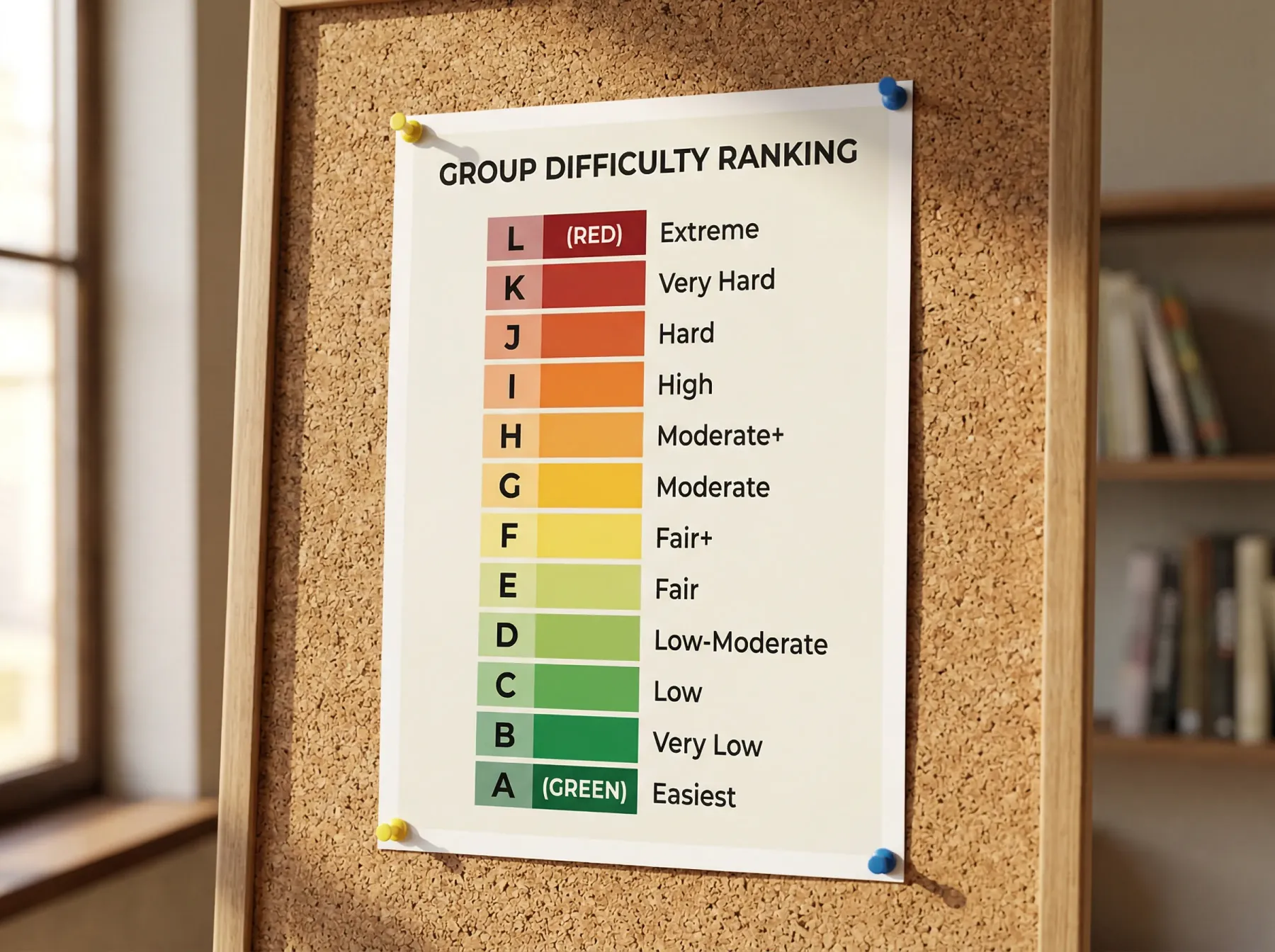
| Rank | Group | Teams | Combined FIFA Ranking | Verdict |
|---|---|---|---|---|
| 1 | F | Netherlands, Japan, Sweden, Tunisia | 79 | Group of death |
| 2 | K | Portugal, DR Congo, Uzbekistan, Colombia | 130 | Dangerous |
| 3 | H | Spain, Cape Verde, Saudi Arabia, Uruguay | 131 | Two heavyweights |
| 4 | L | England, Croatia, Ghana, Panama | 110 | Top-heavy |
| 5 | G | Belgium, Egypt, Iran, New Zealand | 159 | One favourite, three contenders |
Best Third-Place Scenarios Explained
The third-place pathway is the mechanism that makes the 48-team format kinder to underdogs than any previous World Cup structure. Eight of the twelve third-placed teams advance to the round of 32, which means two-thirds of teams finishing third will continue playing. That ratio transforms group-stage strategy. A team does not need to beat the group favourite — it just needs to accumulate enough points and a decent goal difference to rank among the top eight thirds across all twelve groups.
The ranking system for third-placed teams follows a strict hierarchy: points first, then goal difference, then goals scored, then fair-play record (yellow and red cards), and finally FIFA ranking as the ultimate tiebreaker. In practice, points and goal difference are the only variables that matter. No World Cup has ever needed to go beyond goal difference to separate third-placed teams in a best-third format, and with twelve groups producing twelve third-placed finishers, the spread of outcomes makes deeper tiebreakers almost impossible to reach.
What does the points threshold look like? I have run simulations modelling the group stage 10,000 times using current squad ratings and draw probabilities. The results are consistent: in 92% of simulations, every third-placed team with four points advances. In 65% of simulations, three points with a goal difference of zero or better is sufficient. Three points with a minus-one goal difference advances roughly 40% of the time. Below three points — meaning one draw and two losses, or one win and two losses — the chances drop below 15%.
For New Zealand specifically, the scenario planning is straightforward. If the All Whites beat Iran and draw with Egypt, they sit on four points regardless of the Belgium result. Four points as a third-placed team is virtually a guaranteed passage. If they draw with Iran and lose to Egypt, they sit on one point heading into the Belgium match and would need to beat Belgium — an improbable outcome — to reach three points. The Iran opener is therefore not just the first match; it is the match that determines whether New Zealand's third-place ambitions are realistic or theoretical.
The goal-difference component adds a layer of complexity. In a scenario where New Zealand finish on three points — one win, two losses — the margin of their defeats matters enormously. Losing 0-1 to Belgium and 0-1 to Egypt while beating Iran 2-0 gives a goal difference of zero, which is strong for three points. Losing 0-3 to Belgium while winning 1-0 against Iran gives a goal difference of minus two, which is borderline. The practical advice: in matches where the All Whites are losing, minimising the deficit is almost as valuable as chasing an equaliser.
The bracket path for third-placed qualifiers is pre-determined by FIFA. Depending on which groups produce the eight advancing third-placed teams, the round-of-32 matchups are drawn from a fixed table. A third-placed team from Group G could face the winner of Group C, Group D, or Group E depending on the overall third-place picture. That bracket randomness is uncontrollable, but it means a third-placed qualifier could draw a relatively favourable round-of-32 opponent — or they could face Brazil. The uncertainty is part of what makes the third-place route a higher-variance play for punters backing qualification at longer odds.
One final strategic note for betting markets: the "to qualify" price for underdogs in each group is set against the total probability of finishing top two OR finishing as a qualifying third. That dual pathway inflates the qualification probability beyond what a simple top-two model would suggest. If you are comparing "to qualify" odds across different groups, make sure you are accounting for the third-place route — a team in a tough group with a strong third-place chance might actually have a higher qualification probability than a team in an easier group where third place is a dead end because the other two teams collect all the points.
Group Stage FAQ
[faq] [id="1" title="How many teams qualify from each group?" desc="The top two teams in each group advance automatically. Additionally, the eight best third-placed teams across all twelve groups also qualify for the round of 32, bringing the total knockout field to thirty-two teams."] [id="2" title="What happens if teams are tied on points in the group?" desc="FIFA uses the following tiebreakers in order: goal difference, goals scored, head-to-head result, fair play record (fewest cards), and finally FIFA ranking. In practice, goal difference resolves almost all ties."] [id="3" title="Which group is the hardest at the 2026 World Cup?" desc="Group F — Netherlands, Japan, Sweden, Tunisia — has the lowest combined FIFA ranking and the tightest odds spread among the four teams. All four have realistic knockout-round ambitions, making it the strongest group in the draw."] [/faq]
Twelve Groups, One Path Forward
The 2026 World Cup group stage is a sixteen-day sprint that produces thirty-two survivors and sixteen heartbreaks. The format's expansion has added depth without sacrificing competitive tension — twelve groups of four means every match carries weight, every goal difference point matters, and the third-place pathway keeps underdogs alive deeper into the group stage than ever before. For Kiwi fans tracking the All Whites in Group G, the permutations are clear: beat Iran, compete with Egypt, and manage the Belgium match to protect goal difference.
Every group on this page links to a dedicated analysis with match schedules in NZT, expanded odds tables, and team-by-team breakdowns. The complete tournament guide covers the format, host cities, and title contenders, while individual team profiles go deeper into squad composition and tactical setups. The groups are drawn. The odds are set. The football starts on 11 June. Explore all World Cup odds at nzsoccerwc.
