
Nine years of planning, three countries, and forty-eight teams converge on 11 June 2026 when Mexico City’s Estadio Azteca hosts the opening whistle of the largest FIFA World Cup ever staged. For the first time in tournament history, matches will be played across the United States, Mexico, and Canada — sixteen stadiums stretching from Guadalajara to Toronto, from Seattle to Miami. The format itself is brand new: twelve groups of four, a round of 32 before the familiar knockout bracket, and 104 matches crammed into thirty-nine days of football.
I have covered World Cup betting cycles since 2014, and no edition has generated this much structural complexity for punters. A 48-team draw means more groups, more qualification permutations, and a best-third-place mechanism that rewards even narrow defeats with a lifeline. For Kiwi fans, the stakes are personal — the All Whites sealed a historic direct qualification through OFC, landing in Group G alongside Belgium, Egypt, and Iran. Every match kicks off at a civilised afternoon hour in New Zealand Standard Time, which is a rare luxury when the tournament sits on the other side of the Pacific.
This guide covers the complete picture: the expanded format and what it means for results, all twelve groups mapped out, a full schedule converted to NZT, broadcast options from New Zealand, and a data-backed look at the teams most likely to lift the trophy on 19 July at MetLife Stadium. Whether you are planning watch parties in Auckland, tracking odds on TAB NZ, or simply trying to understand how forty-eight teams squeeze into a single bracket, start here.
The New 48-Team Format Explained
When FIFA confirmed the expansion from 32 to 48 teams back in 2017, the immediate reaction from pundits was scepticism. More teams meant more mismatches, the argument went, and the group stage would be diluted. Having watched the qualification cycles play out across all six confederations, I think the opposite is true. The new format has produced groups with genuine four-way competition, partly because the extra slots went to confederations that historically sent only their elite — Africa jumped from five to nine berths, Asia from four to eight, and CONCACAF from three to six. The result is a tournament where mid-ranked nations bring squads full of European league experience rather than token participants padding the numbers.
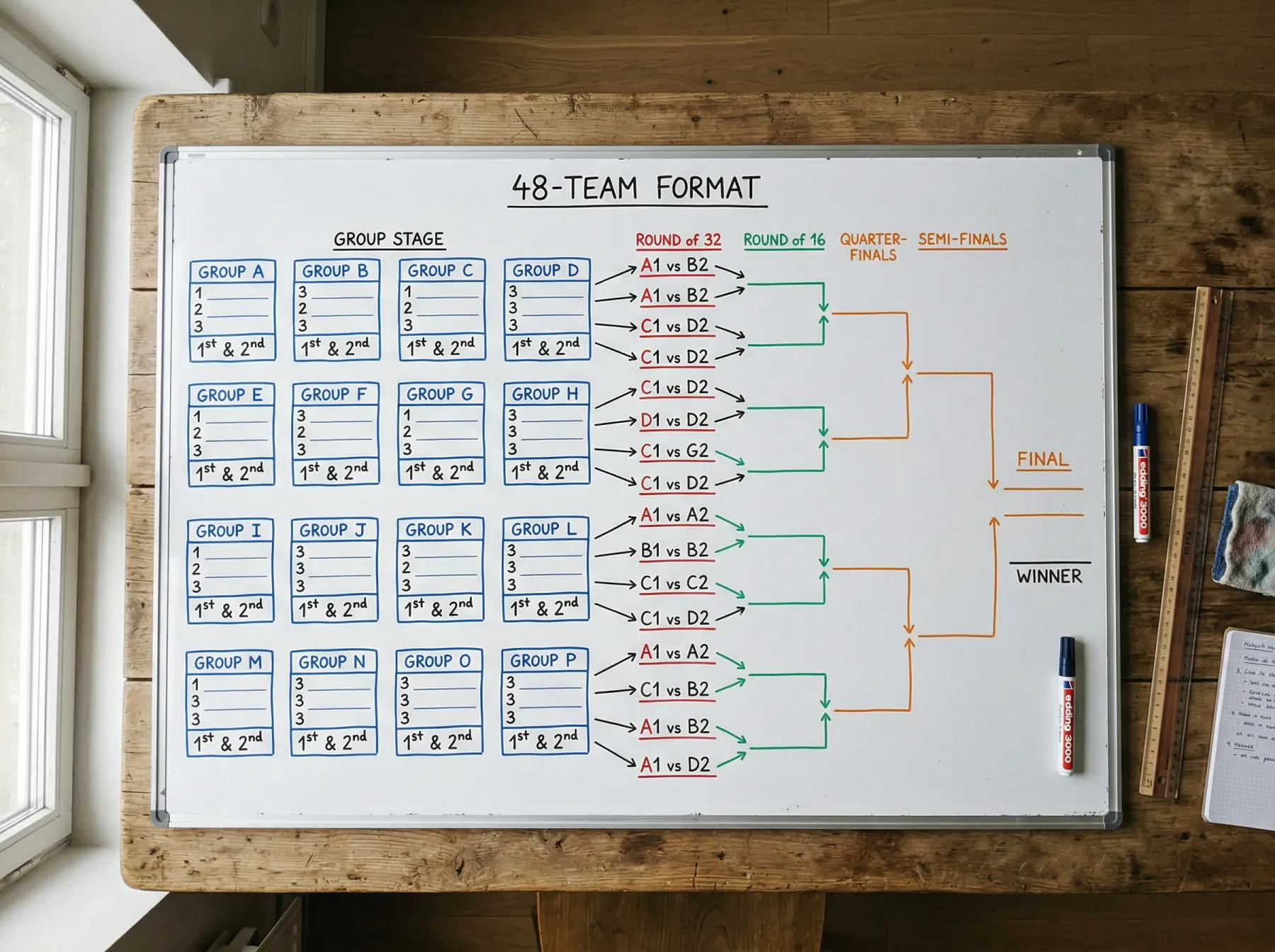
The structural mechanics deserve a close look. Forty-eight teams split into twelve groups of four. Each team plays three group matches — same as before. The top two finishers in every group advance automatically, giving us twenty-four guaranteed qualifiers from the group stage. Then the eight best third-placed teams also progress, bringing the total to thirty-two for the knockout rounds. From the round of 32 onward, it is single-elimination football all the way to the final.
That best-third-place rule is where the format gets tactically interesting. In a four-team group, finishing third with four points — say, one win, one draw, one loss — could be enough to squeeze through. Compare that to the old 32-team World Cup, where third place in a group of four meant elimination. The practical impact for punters is significant: a team like New Zealand, drawn into a tough Group G, does not need to finish above Belgium to stay alive. A single win and a draw might be enough to claim one of those eight wildcard spots, depending on results elsewhere.
The maths behind the best-third-place cutoff draws from Euro 2016, the last major tournament to use this mechanism with a 24-team field. In that tournament, the threshold for advancing as a third-placed team was three points with a goal difference of minus one. Scale that to twelve groups instead of six, and the bar stays roughly the same — three to four points should suffice in most simulations I have run. The key variable is goal difference, which makes every match meaningful right down to the final whistle.
Another format change that often gets overlooked: the round of 32 is not seeded purely by group position. FIFA has pre-determined the bracket paths, meaning a group winner from Group A faces a specific third-placed team, and so on. This creates bracket asymmetry — some sides of the draw are heavier than others. Punters who track bracket paths can identify knockout-round value before the group stage even finishes. A team that tops an easy group might walk into a quarter-final against the tournament favourite, while a third-placed qualifier from a brutal group could land on the softer side.
For the group stage itself, the schedule compresses three matchdays into roughly ten days per group. Each group’s final two matches kick off simultaneously to prevent collusion, identical to previous World Cups. With twelve groups running in parallel across three countries, that means up to six matches per day during the group phase — a density that creates both viewing overload and betting opportunity.
The total match count of 104 dwarfs the 64 matches from Qatar 2022. From a betting perspective, more matches mean more data points accumulating quickly, which is valuable for live and in-play markets once the tournament is underway. Group-stage patterns — which teams press high, which sit deep, how referees officiate in specific stadiums — become visible faster when six games run daily. I will be tracking those patterns in real time across the tournament.
One final structural note: extra time and penalty shootouts apply from the round of 32 onward. There is no extra time in the group stage — draws stand. This matters for match betting markets where the three-way 1X2 price is the bread-and-butter wager. In a format that rewards a draw with a point toward best-third-place calculations, expect more conservative group-stage football from underdogs who would rather take a point than chase a win and concede on the counter. If you are betting totals, keep that defensive incentive in mind.
Three Host Nations — USA, Mexico, Canada
The last time a World Cup was shared between co-hosts was 2002, when South Korea and Japan split duties. That tournament taught FIFA a logistical lesson: two countries meant two sets of infrastructure, two time zones, and two very different football cultures to manage. Now multiply that by one and a half. The 2026 edition spans three nations, five time zones if you count Hawaii-Aleutian, and a geographical footprint wider than all of Western Europe. It is an ambitious experiment, and the venue allocation reflects a clear hierarchy.
The United States hosts the lion’s share with eleven stadiums and seventy-eight matches, including every knockout-round game from the quarter-finals onward. MetLife Stadium in East Rutherford, New Jersey — just across the Hudson from Manhattan — hosts the final on 19 July. The American venues are overwhelmingly NFL stadiums repurposed for football, which means capacities north of 60,000 in most cases and the kind of corporate infrastructure FIFA demands. SoFi Stadium in the Los Angeles area is particularly relevant for Kiwi fans: it hosts Iran versus New Zealand on 16 June, the All Whites’ tournament opener.
Mexico contributes three stadiums and thirteen matches, anchored by the iconic Estadio Azteca in Mexico City. The Azteca holds the distinction of being the only stadium to host two World Cup finals — 1970 and 1986 — and it will open this tournament with Mexico versus South Africa on 11 June. The two other Mexican venues, Estadio BBVA in Monterrey and Estadio Akron in Guadalajara, handle group-stage fixtures. Mexico’s matches are concentrated in the tournament’s first two weeks, after which the action shifts north.
Canada fields two venues: BMO Field in Toronto and BC Place in Vancouver. Thirteen matches are scheduled across the two cities, all in the group stage and early knockout rounds. BC Place is the venue to circle for New Zealand supporters — the All Whites play their second and third group matches there, against Egypt on 22 June and Belgium on 27 June. Vancouver’s Pacific time zone means those 9 PM ET kickoffs translate to 1 PM NZT and 3 PM NZT respectively, which is ideal afternoon viewing in New Zealand.
Travel logistics for teams are a genuine tactical factor. A group that spans Dallas, Miami, and Seattle could force squads to cross three time zones and cover 8,000 kilometres in ten days. Group G is relatively compact by comparison — Los Angeles and Vancouver are on the same Pacific coast corridor, roughly a two-hour flight apart. That geographical clustering benefits all four teams, but it is a particular advantage for New Zealand, whose squad will not face the jet lag and disruption that plagues teams bouncing between East and West Coast venues.
Altitude is another variable. Mexico City sits at 2,240 metres above sea level, a factor that has historically affected visiting European teams unused to thin air. Monterrey is lower at around 540 metres, and Guadalajara at 1,560 metres. All US and Canadian venues are at or near sea level. For betting purposes, altitude adjustments matter most in the Mexican group-stage matches — expect slightly lower-scoring games and more fatigue-related substitutions in Mexico City fixtures.
Stadium surfaces are uniformly natural grass or hybrid grass across all sixteen venues, following FIFA’s mandate. Several American stadiums — including SoFi and MetLife — have installed temporary grass pitches over their usual artificial surfaces, a process that began months ahead of the tournament. Pitch quality should not be a differentiator between venues, though acclimatisation to specific stadium dimensions and atmospheres certainly will be.
All 12 Groups at a Glance
I spent the morning after the draw printing out all twelve groups on a whiteboard, colour-coded by confederation, and the pattern that jumped out was balance. Previous World Cup draws occasionally produced a group of death alongside a group of gentle passage. This draw has competitive depth spread more evenly, partly because forty-eight teams dilute the concentration of heavyweights. Every group contains at least one FIFA top-20 nation, and ten of the twelve groups feature a genuine four-way contest for the two automatic spots.
Group A pairs hosts Mexico with South Korea, South Africa, and Czechia. Mexico carry home support in the opening match at the Azteca but face a tactically astute South Korean side and a Czechia team that battled through UEFA playoffs, beating Denmark on penalties to claim the last European berth. South Africa return to the World Cup for the first time since hosting in 2010, bringing pace and physicality. This group is wide open beyond Mexico’s favouritism.
Group B sends co-hosts Canada into a quartet with Bosnia and Herzegovina, Qatar, and Switzerland. The Canadians have home matches at BMO Field in Toronto, but Switzerland are the class act here — perennial round-of-16 qualifiers with a deep squad of Serie A and Bundesliga regulars. Bosnia, fresh from a playoff upset of Italy, arrive with momentum and nothing to lose. Qatar’s 2022 home tournament ended in group-stage elimination, and they face a tougher test on foreign soil.
Group C is headlined by Brazil, joined by Morocco, Haiti, and Scotland. Brazil are obvious favourites, but Morocco — 2022 semi-finalists — are no pushovers. The Atlas Lions bring a defence that conceded just one non-penalty goal across their entire run in Qatar. Scotland return to the World Cup for the first time since 1998, while Haiti make their debut — a Cinderella story from CONCACAF qualifying. The battle for second place between Morocco and Scotland is the subplot to follow.
Group D features the other co-hosts, the United States, alongside Paraguay, Australia, and Turkey. The Socceroos in Group D is a storyline Kiwi fans will track closely given the trans-Tasman rivalry. The USA have home advantage and a golden generation peaking at the right time, but Turkey — who edged Kosovo 1-0 in the UEFA playoff — are a disruptive force with Bundesliga talent across the spine. Paraguay and Australia contest the third-place lifeline.
Group E looks comfortable for Germany on paper: Curaçao, Côte d’Ivoire, and Ecuador. But Côte d’Ivoire won the 2024 Africa Cup of Nations and Ecuador have qualified for three consecutive World Cups. Curaçao are the minnows, making their debut and likely to struggle, but the other three matches in this group are genuinely competitive.
Group F is arguably the most balanced quartet in the draw. Netherlands, Japan, Sweden, and Tunisia each bring distinct tactical identities. Japan have emerged as dark-horse contenders with a squad now anchored in the top five European leagues. Sweden return via the playoff route after beating Poland 3-2 in a pulsating tie. Tunisia add defensive resilience and tournament experience from Qatar 2022. I would not be confident predicting the finishing order in this group.
Group G — the one that matters most to us — contains Belgium, Egypt, Iran, and New Zealand. Belgium are clear favourites, Egypt bring Mohamed Salah and continental pedigree, Iran are Asia’s most experienced World Cup campaigners, and the All Whites arrive on the back of a historic OFC qualification. The full breakdown lives on the dedicated Group G page, but the short version is that third place is a realistic target for New Zealand, and third place with four points could mean a round-of-32 ticket.
Group H pits Spain against Cape Verde, Saudi Arabia, and Uruguay. Two heavyweights in Spain and Uruguay make this a group where third place is a long shot for the other two. Spain’s young squad — built on the Euro 2024 triumph — is among the deepest in the tournament, and Uruguay bring the kind of tournament steel that has produced quarter-final finishes in three of the last four World Cups.
Group I has France as overwhelming favourites, with Senegal, Iraq, and Norway contesting the remaining spots. Senegal, 2022 round-of-16 qualifiers, are the strongest second seed in any group. Iraq return to the World Cup for the first time since 1986, having beaten Bolivia in the intercontinental playoff. Norway’s golden generation — led by Erling Haaland — finally reaches a major tournament.
Group J belongs to defending champions Argentina, grouped with Algeria, Austria, and Jordan. Argentina’s depth allows Lionel Scaloni to rotate freely across three matches. The real intrigue is whether Algeria or Austria claim second place. Jordan, making their World Cup debut, are unlikely to challenge but carry the pride of a region that rarely qualifies.
Group K features Portugal alongside DR Congo, Uzbekistan, and Colombia. Portugal and Colombia are the top-two favourites, but DR Congo — who beat Jamaica in the intercontinental playoff — have a squad packed with European-based talent and could spring a surprise. Uzbekistan are tournament debutants from the Asian confederation.
Group L closes the draw with England, Croatia, Ghana, and Panama. England and Croatia replayed their 2018 semi-final rivalry in the draw, and both should progress. Ghana add African flair, and Panama return after their breakthrough in 2018. This group has a clear top two and a fight for third that probably does not yield enough points for a best-third-place berth.
Key Dates and Kickoff Times in NZT
Time zone conversion is the single most overlooked factor for Kiwi fans following a tournament in the Americas. I learned this the hard way during Russia 2018, when I set an alarm for what I thought was a 2 AM kickoff and woke up to find I had missed the first half by an hour because daylight saving had shifted. For 2026, the good news is straightforward: New Zealand Standard Time is UTC+12, and since the tournament runs through the Southern Hemisphere winter, there is no daylight saving adjustment. Eastern Time in June and July is UTC-4 (EDT), making the gap a clean sixteen hours ahead. Pacific Time is UTC-7, so NZST is nineteen hours ahead.
The tournament opens on 11 June at the Estadio Azteca in Mexico City, where Mexico face South Africa. That 12 PM ET kickoff translates to 4 AM NZT on 12 June — a rough start for early risers, but it is the only match that day so dedicated fans can nap through the afternoon and still catch the replay. Opening ceremonies typically add thirty minutes before the first whistle.
Group-stage matches generally kick off at three main windows in Eastern Time: 12 PM, 3 PM, 6 PM, and 9 PM ET. The NZT equivalents are 4 AM, 7 AM, 10 AM, and 1 PM the next day. That 9 PM ET slot — the prime-time window for North American audiences — is the sweet spot for New Zealand viewers, falling right in the early afternoon. All three All Whites group matches are scheduled in that late-evening ET window, which means 1 PM and 3 PM NZT kickoffs. You could not design a better viewing schedule for a country twelve time zones away.
| Match | Date (NZT) | Kickoff (NZT) | Venue |
|---|---|---|---|
| Iran vs New Zealand | 16 June | 1:00 PM | SoFi Stadium, Los Angeles |
| New Zealand vs Egypt | 22 June | 1:00 PM | BC Place, Vancouver |
| New Zealand vs Belgium | 27 June | 3:00 PM | BC Place, Vancouver |
Beyond the group stage, the round of 32 begins on 28 June and runs through 2 July. Quarter-finals are scheduled for 4-5 July, semi-finals on 8-9 July, and the final on 19 July at MetLife Stadium in East Rutherford, New Jersey. The final kicks off at 3 PM ET, which is 7 AM NZT on 20 July — an early start, but a Sunday morning that most fans will happily set an alarm for.
There is a ten-day gap between the semi-finals and the final, longer than any previous World Cup. FIFA designed this window to accommodate rest and potential travel between host cities, but it also gives the betting market an extended period to settle knockout-round prices. If New Zealand make the round of 32, their match would likely fall between 28-30 June NZT — barely forty-eight hours after the final group game. Turnaround time matters for squad depth assessments.
One scheduling detail worth noting: the final two group matches in each group kick off simultaneously to prevent dead-rubber manipulation. For Group G, that means New Zealand versus Belgium and Egypt versus Iran both start at 11 PM ET on 26 June, which is 3 PM NZT on 27 June. If the All Whites’ fate depends on results in the other match, you will need a second screen — or a very fast-refreshing live odds feed.
For the full 104-match fixture list with every kickoff converted to NZT, the dedicated schedule page will track results, scores, and updated odds as the tournament progresses.
How to Watch from New Zealand
I remember the chaos of trying to find a reliable stream during the 2022 World Cup from a hotel room in Wellington, flipping between apps while the buffering wheel spun through a Messi assist. Broadcasting rights for football in New Zealand have historically bounced between providers, and each cycle brings a different answer to the question “where do I actually watch this?” For 2026, the situation has consolidated somewhat, but it still pays to sort your setup before the opening whistle rather than scrambling at 1 PM on a Monday afternoon.
Sky Sport holds primary broadcast rights for FIFA tournaments in New Zealand and is expected to carry all 104 matches across its linear channels and streaming platform Sky Sport Now. A Sky Sport Now subscription provides access on mobile, tablet, smart TV, and desktop — the most flexible option for fans who want to follow both All Whites matches and neutral fixtures across the group stage. Sky’s coverage typically includes pre-match analysis, live commentary, and post-match highlights.
Free-to-air coverage is the wildcard. In previous cycles, TVNZ secured sub-licensing deals to broadcast selected matches — typically the opening game, All Whites fixtures, semi-finals, and the final — on free channels accessible to every household. Whether a similar arrangement exists for 2026 will depend on negotiations that tend to finalise in the months before the tournament. If TVNZ or Three pick up a highlights package or live sub-license, it would dramatically expand the casual audience for All Whites matches.
For Kiwis abroad — whether travelling in Australia, Southeast Asia, or following the team to Los Angeles and Vancouver — a VPN paired with your existing Sky Sport Now subscription is the practical solution. Streaming quality depends on local internet infrastructure, but Sky’s platform has improved significantly since its 2022 iteration, with lower latency and adaptive bitrate that handles variable connections.
Social media will fill the gaps. FIFA’s official channels on YouTube and social platforms typically post near-live highlights within minutes of goals, which is useful for catching up on matches you cannot watch live. The FIFA+ platform, launched before Qatar 2022, may offer free streaming of select matches in territories without exclusive broadcast deals, though New Zealand’s Sky agreement likely limits its local availability for live fixtures.
Watch parties are the social glue. With All Whites matches kicking off between 1-3 PM NZT on weekdays, pubs and sports bars across Auckland, Wellington, and Christchurch will be running midday screenings. The 2010 World Cup — the last time New Zealand participated — saw packed bars at odd hours across the country. This time the schedule is friendlier, and the emotional investment is higher. If you are planning a group viewing, book your spot early; the Iran match on 16 June will be the most-watched football event in New Zealand in sixteen years.
Title Contenders — Quick Comparison
Every tournament cycle produces a consensus top five in the outright market, and every cycle at least one of those five disappoints before the quarter-finals. In 2022 it was Germany and Belgium crashing out in the groups. In 2018 it was Germany again, plus Spain and Argentina stumbling in the round of 16. I bring this up not to be contrarian but to underscore a data point: backing a pre-tournament favourite at short odds is historically a losing proposition unless you pick the right one. The outright market is a puzzle, not a slam dunk.
| Team | Outright Odds | FIFA Ranking | Last WC Finish | Key Strength |
|---|---|---|---|---|
| Brazil | 5.50 | 3 | QF (2022) | Squad depth across all lines |
| France | 6.00 | 2 | Final (2022) | Mbappe-led attack, tournament pedigree |
| Argentina | 6.50 | 1 | Winners (2022) | Defending champions, Scaloni’s system |
| England | 8.00 | 4 | QF (2022) | Premier League core, set-piece threat |
| Spain | 8.50 | 5 | R16 (2022) | Euro 2024 winners, youngest squad |
| Germany | 10.00 | 8 | Group stage (2022) | Post-Euro 2024 rebuild, home-region form |
| Portugal | 12.00 | 6 | QF (2022) | Generational transition completed |
| Netherlands | 14.00 | 7 | QF (2022) | Tactical versatility, European depth |
Brazil sit at the top of most books, and the reasoning is straightforward: they have the deepest squad in the tournament. The Seleção can field two entirely different starting elevens with roughly equal quality, a luxury no other team matches. Their quarter-final exit in 2022 — a penalty shootout loss to Croatia — masked a campaign where they were the best attacking team in the field. The concern is psychological: Brazil have not won the World Cup since 2002, and the weight of that drought is real inside the dressing room.
France are the perennial tournament machine. Didier Deschamps’ side reached back-to-back finals in 2018 and 2022, winning the first and losing the second on penalties. Kylian Mbappe is now the undisputed centrepiece, flanked by a midfield that blends physicality and technical quality. France’s weakness is depth at full-back and a tendency to start tournaments slowly — they lost to Tunisia in the 2022 group stage with a rotated squad and barely scraped past Australia in their opener.
Argentina enter as defending champions, but the squad is evolving. Whether Lionel Messi features at all is the question that dominates their pre-tournament narrative. Even without him, Scaloni’s tactical framework — a mid-block with rapid transitions — has been internalised by a generation of players who won the Copa America in 2024 with Messi as a bench option. The depth behind the front line is the concern; Argentina’s backup attackers lack the quality of Brazil’s or France’s second-choice forwards.
England’s price at 8.00 reflects a squad loaded with Premier League quality but burdened by a tournament record that has produced more near-misses than trophies. The 2024 Euro final loss lingers. Their set-piece game is elite — no team in world football scores more from dead-ball situations — and the defensive structure under the current setup is sound. If England find a way to unlock opponents in open play rather than relying on moments, they are genuine contenders.
Spain are the value pick in this tier. The Euro 2024 triumph was built on a squad with an average age of twenty-four, meaning the same core will be a year more experienced and approaching peak condition. Their midfield press, orchestrated from deep, suffocates opponents who try to play through them. The risk is a lack of a proven World Cup-level striker — Spain’s goals came from wide rotations and late arrivals in 2024, which is harder to sustain across seven knockout matches.
Germany, Portugal, and the Netherlands round out the top eight. Germany’s Euro 2024 hosting cycle reignited their competitive fire, but translating that to a North American summer is a different challenge. Portugal have completed the generational transition from Cristiano Ronaldo’s era, building around a spine of players aged 23-27 with Champions League experience. The Netherlands are tactically the most adaptable team in the group — capable of switching between a 3-4-3 and a 4-3-3 mid-match — but lack a genuine goal-scoring talisman at centre-forward.
Beyond the big eight, the dark-horse bracket includes Japan, Morocco, Colombia, and the USA. Japan’s squad is anchored in the top five European leagues, a transformation from even a decade ago. Morocco proved in 2022 that defensive organisation and counter-attacking speed can beat anyone over ninety minutes. Colombia carry South American flair and an underrated defensive record. And the USA have home advantage — a factor that has pushed hosts to at least the quarter-finals in five of the last seven tournaments.
Common Questions About the 2026 World Cup
What This Tournament Means for New Zealand
The 2026 FIFA World Cup is not just another tournament — it is a structural reset for the sport’s biggest competition. Forty-eight teams, three host nations, and a format that rewards resilience as much as brilliance create a landscape where upsets are more likely and underdogs have genuine pathways. For New Zealand, this is the first direct World Cup qualification in the country’s history, and the group-stage schedule could not be kinder in terms of viewing times and travel logistics for the squad.
I will be covering every angle of this tournament across the site — from detailed odds breakdowns to individual team profiles, group analysis, and live updates once the ball starts rolling. The 2026 World Cup guide you have just read is the foundation; the pages linked throughout go deeper into each topic. Bookmark this hub, check back as the tournament approaches, and enjoy what promises to be the most expansive World Cup in the sport’s history.