
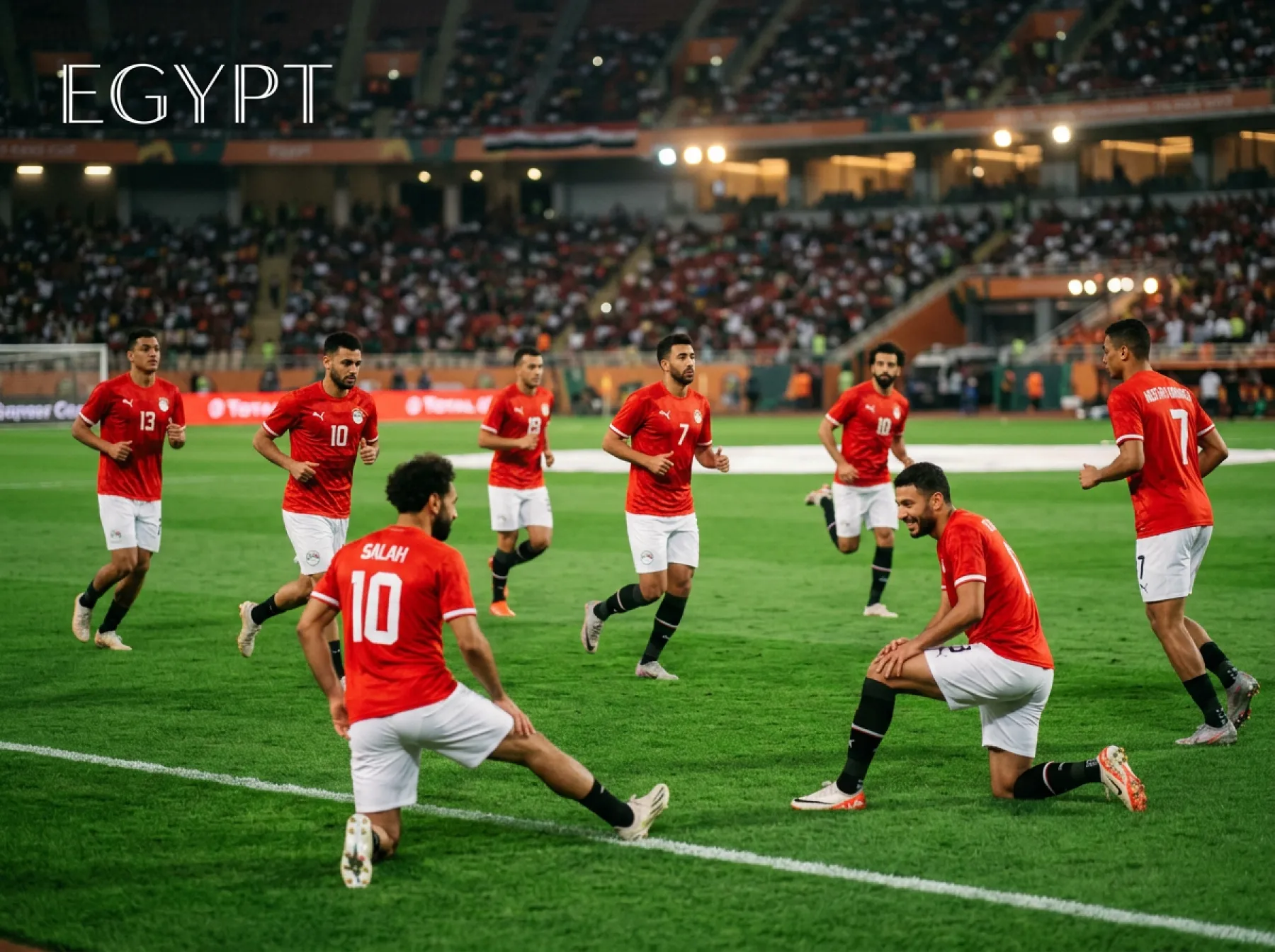
Mo Salah at a World Cup is something NZ punters should care about — not just because he is one of the finest footballers of his generation, but because Egypt are in Group G with the All Whites, and Salah’s presence transforms every match Egypt play from a tactical contest into a referendum on whether one player can carry an entire nation. At 34, Salah’s pace has diminished fractionally from its 2018 peak, but his positioning, finishing and ability to create goals from half-chances remain at an elite level that very few players in World Cup history have maintained into their mid-thirties. Egypt’s return to the World Cup — their first appearance since 2018 — is built on Salah’s shoulders, and the All Whites’ second group match against Egypt on 22 June in Vancouver is the fixture that could define New Zealand’s entire tournament.
Key Players — Mo Salah and the Squad
Salah’s numbers at Liverpool across the 2025-26 Premier League season — 19 goals and 13 assists in 34 appearances — demonstrate that age has not eroded his output, merely shifted its composition. Where the younger Salah devastated defences with raw speed on the right wing, the current version relies on positioning, timing of runs and an almost preternatural ability to find space inside the penalty area. His movement off the ball is the key: Salah drifts inward from the right, arriving in central positions between centre-backs to receive passes that he converts with either foot. For opponents, the challenge is not simply marking Salah — it is preventing the supply chain that feeds him, because any ball into the right half-space has a chance of reaching a player who converts at a rate above 25% from inside the box.
Beyond Salah, Egypt’s squad features a blend of African league experience and European-based professionals. Mohamed Elneny provides veteran midfield stability — his years at Arsenal, while not always in the starting eleven, instilled a tactical awareness and passing precision that serves as the backbone of Egypt’s midfield structure. Mahmoud Trezeguet offers width and crossing delivery from the left side, creating the supply line that reaches Salah through diagonal passes and cut-backs from wide areas. Younger players from the Egyptian Premier League and Saudi Pro League fill the squad positions, and several have emerged from the recent AFCON campaigns with enhanced reputations and tournament experience that translates to World Cup conditions. The depth is limited compared to European opponents — Egypt’s bench lacks the quality to change matches through substitutions in the way France or England can — but the starting eleven is competitive, well-organised and capable of executing the low-block, counter-attacking system that African Cup of Nations campaigns have refined over multiple cycles. When the eleven on the pitch function as a collective unit, Egypt are capable of frustrating far superior squads for ninety minutes.
The goalkeeping position belongs to Mohamed El-Shenawy, whose AFCON performances have been consistently strong across three tournament cycles. El-Shenawy’s shot-stopping and penalty-saving record give Egypt an edge in close matches — his reflexes inside the six-yard box are among the best of any goalkeeper at the tournament, and his communication with the back four creates a defensive unit that is difficult to break down when set and organised. The centre-back pairing provides the aerial dominance and physical presence needed to compete against European and South American strikers, though their recovery pace against quick counter-attacks is a vulnerability that the All Whites’ Chris Wood is unlikely to exploit but that Belgium’s Doku certainly will. Egypt’s defensive record during CAF qualifying — among the best in the confederation with just five goals conceded across ten matches — reflects a team that builds results on clean sheets and clinical finishing rather than open, expansive football.
Group G — Belgium, Iran, New Zealand
Egypt’s Group G position is fascinating from a betting perspective. They are clearly behind Belgium but represent the strongest challenger for second place, with Iran and New Zealand competing for the third-place scraps. Egypt’s odds to qualify from the group sit around 2.10 for top two and 1.55 including best third — prices that reflect their status as the group’s second-favourite without acknowledging the possibility that they could push Belgium for top spot if the opening match goes their way.
The Belgium match on matchday one sets the tone. A draw or upset victory would transform Egypt’s campaign from a battle for survival to a genuine challenge for group supremacy. Salah’s ability to exploit Belgium’s high defensive line — Faes and Debast lack the recovery pace to handle his diagonal runs — creates a specific tactical matchup that favours Egypt in transition. If Belgium press high, the space behind their defence is exactly the territory where Salah has built his career.
The Egypt vs New Zealand match on 22 June at BC Place, Vancouver (1:00 PM NZT) is the pivotal fixture for both teams. Egypt will treat this as a must-win if they lose to Belgium on matchday one, while New Zealand need a result to maintain any hope of progressing as a best third-placed team. The tactical matchup favours Egypt — Salah’s quality against New Zealand’s defensive system is the clearest individual mismatch in Group G — but tournament football produces surprises, and the All Whites’ defensive organisation should not be underestimated.
| Market | Belgium | Egypt | Iran | New Zealand |
|---|---|---|---|---|
| Group G winner | 1.40 | 4.50 | 6.00 | 21.00 |
| To qualify (top 2) | 1.12 | 2.10 | 3.00 | 8.50 |
Egypt Odds — Group and Match Markets
Egypt’s outright odds (around 100.00-150.00) are irrelevant for serious punting — the squad simply does not have the depth to win seven consecutive matches against progressively tougher opponents. The value sits entirely in group-stage and match-specific markets. Egypt to finish in the top two of Group G at 2.10 is the anchor bet: they need to beat Iran and New Zealand (both achievable with Salah in the squad) and avoid defeat against Belgium (the draw is realistic given the tactical matchup). Four or five points from three matches should secure second place.
Match betting for Egypt vs New Zealand on 22 June offers NZ punters a direct head-to-head with their own team. Egypt are priced around 1.85, the draw at 3.30, and New Zealand at 4.80. From a neutral analytical perspective, Egypt at 1.85 is slightly too short — the implied probability of 54% overestimates their chances against a defensively disciplined All Whites side that will approach the match with desperation and organisation. The draw at 3.30 (30.3% implied) is where I see the best value in this fixture: both teams playing for survival, both prioritising defensive stability, and a tight, low-scoring match that neither side can afford to lose.
Egypt vs New Zealand — What to Expect
This is the match that NZ punters will circle on their calendar, and the tactical breakdown deserves detailed treatment. Egypt will set up in a 4-2-3-1 with Salah on the right of the attacking three, looking to drift inside and receive between the lines. New Zealand’s 5-4-1 defensive structure means five defenders across the back line, but the wing-backs will be stretched by Egypt’s width, creating potential gaps in the channels that Salah can exploit. The specific danger zone is the space between New Zealand’s left wing-back and the nearest centre-back — if Egypt can isolate Salah in that channel, his finishing quality makes every opportunity a genuine goal chance.
New Zealand’s counter-attacking approach could trouble Egypt if the match remains tight past the hour mark. Chris Wood’s aerial presence against Egyptian centre-backs who are strong in one-on-one defending but less comfortable under sustained aerial bombardment from set pieces creates opportunities that the All Whites must maximise. Corners, free kicks and long throws into the box are New Zealand’s most probable route to a goal, and Egypt’s record defending set pieces at AFCON has been inconsistent.
The match profile screams under 2.5 goals. Both teams will approach cautiously, both prioritise defensive structure over attacking risk, and the stakes are too high for either side to commit numbers forward recklessly. Under 2.5 at around 1.85 is a solid selection for NZ punters who want to back the match profile without choosing a winner.
Egypt’s World Cup Record
Egypt’s World Cup history is surprisingly thin for the most successful team in African football. Their first appearance was in 1934 — making them the first African nation to compete at a World Cup — followed by a 56-year absence before the 1990 tournament in Italy. The 2018 World Cup in Russia was their most recent appearance, where Salah’s shoulder injury (suffered in the Champions League final against Real Madrid three weeks earlier) robbed Egypt of their best player for the opening match against Uruguay and limited his impact throughout. Egypt lost all three group matches, a result that reflected both the Salah situation and a squad that lacked the depth to compete without its star.
The 2026 squad is better prepared. Eight years of AFCON campaigns have hardened the core players, the tactical system is more sophisticated than the 2018 vintage, and Salah arrives fit and motivated for what may be his final World Cup. For NZ punters tracking Group G, Egypt are the opponent the All Whites must respect most — not because they are the strongest team in the group (Belgium hold that distinction) but because Egypt occupy the position immediately above New Zealand in the group hierarchy, and the direct head-to-head result on 22 June will determine whether the All Whites’ World Cup dream lives or dies.