
Loading...
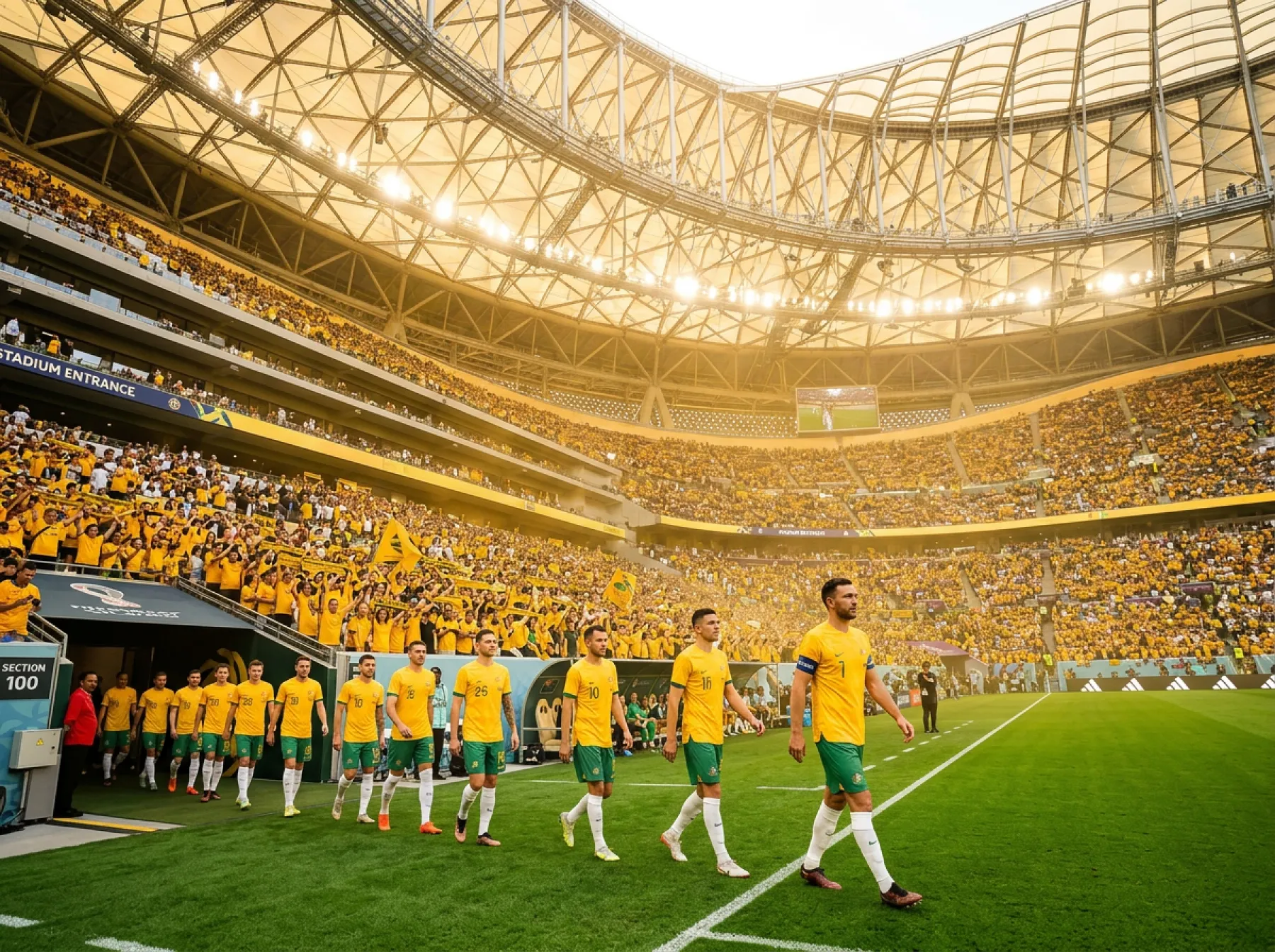
For Kiwi fans, no opponent at the 2026 World Cup carries quite the same emotional charge as the Socceroos. The trans-Tasman rivalry extends across every sport, and watching Australia compete in Group D — against the USA, Paraguay and Turkey — will generate as much interest in New Zealand pubs as the All Whites’ own matches. Australia at the 2026 World Cup are an outsider in every statistical model: ranked outside the top thirty, drawn in a group with the host nation, and carrying a World Cup record that features just one knockout-round victory in the tournament’s history. But the Socceroos have surprised before — their 2022 World Cup round-of-16 appearance, their first in sixteen years, demonstrated that Australian football has developed beyond the route-one pragmatism that characterised previous campaigns. For NZ punters, Australia offer limited outright value but genuine interest in group-stage and match-specific markets.
The Socceroos’ Evolving Talent Pool
The Socceroos’ squad strength centres on a core of A-League and European-based players who combine physical intensity with improving technical quality. The emergence of players in the Scottish Premiership, Championship and Eredivisie has deepened the talent pool beyond the handful of elite-level players that previous Australian squads relied upon. The centre-forward role remains critical — a target man capable of holding the ball up against physical defenders and bringing wide players into the game is the foundation of Australia’s system. Jackson Irvine provides midfield leadership and aerial presence, combining heading ability with passing range that links defence to attack. His experience across multiple European leagues adds a tactical awareness that younger squad members rely upon in competitive matches. The creative midfield options have improved: players with Eredivisie and Championship experience add a passing dimension that previous Socceroos squads lacked, and the manager’s willingness to build from the back rather than resorting to long balls represents an evolution in Australian football philosophy.
Defensively, Australia will rely on the disciplined low-block structure that carried them through the 2022 group stage, where they beat Tunisia and Denmark before losing narrowly to France and Argentina. The back four operates as a compact, well-drilled unit that prioritises positioning over individual duels — a necessary approach given the physical and technical superiority of most World Cup opponents. The goalkeeping position features Mat Ryan, whose experience across European leagues including Brighton, Real Sociedad and Copenhagen provides the shot-stopping quality needed to keep matches tight. Ryan’s distribution has improved significantly, allowing Australia to build counter-attacks from goalkeeper possession rather than resorting to aimless clearances. Australia’s defensive record during AFC qualifying was solid, conceding fewer than a goal per match across the final stage, and that solidity is the platform on which any positive World Cup result will be built. Set-piece defence is a potential vulnerability — Australia conceded from corners in three of their ten qualifiers — and the aerial threat of opponents like Turkey and the USA will test the Socceroos’ ability to defend dead-ball situations under the pressure of a World Cup environment.
Group D — USA, Paraguay, Turkey
Drawing the host nation is a challenge that the Socceroos could have done without. The USA’s home advantage — crowd support, climate familiarity, stadium knowledge — adds an extra dimension to an already difficult group. Turkey, who qualified through the UEFA playoffs, bring physicality and pressing intensity that will test Australia’s build-up play. Paraguay offer South American defensive resilience and counter-attacking threat. This is a group where third place is the realistic target for Australia, with the hope of accumulating enough points to progress as one of the eight best third-placed teams.
The USA vs Australia match is the fixture NZ fans will watch most closely from a trans-Tasman perspective. The Socceroos’ chances of taking points from the hosts depend on their ability to defend deep, limit the USA’s wide play, and exploit set-piece opportunities where Australia’s aerial advantage could prove decisive. The Paraguay match is the must-win fixture for Australia — a South American opponent without the star quality of Brazil or Argentina, and one where the Socceroos’ physical approach and European-based midfield experience should create competitive equality.
| Market | USA | Turkey | Australia | Paraguay |
|---|---|---|---|---|
| Group D winner | 1.70 | 2.80 | 6.00 | 8.00 |
| To qualify (incl. best 3rd) | 1.10 | 1.30 | 2.80 | 3.50 |
Socceroos Odds
Australia’s outright odds (100.00+) are not worth backing. The value sits in “to qualify including best third” at 2.80, which requires the Socceroos to accumulate three or four points — realistically a win against Paraguay and a draw against Turkey or the USA. That is achievable, and 2.80 represents reasonable value for a squad that reached the round of 16 at the 2022 World Cup against stronger group-stage opponents.
The Trans-Tasman Angle
For Kiwi fans, tracking Australia’s progress serves a dual purpose: trans-Tasman rivalry and comparative analysis. If Australia navigate Group D and reach the Round of 32, it validates the progress of football in Oceania and Australasia — a signal that the region’s investment in player development and competitive structures is producing results at the global level. If Australia exit in the group stage, the comparison with New Zealand’s own campaign in Group G becomes even more poignant.
The Socceroos’ betting markets offer a specific opportunity for NZ punters who follow both teams. Multi-bets combining New Zealand to draw with Iran and Australia to beat Paraguay create a trans-Tasman double that prices attractively (approximately 8.00-10.00) and represents a genuine emotional investment in both nations’ World Cup campaigns. Whether the footballing outcomes justify the emotional outlay is, of course, another matter entirely — but that has never stopped a Kiwi or Aussie from having a punt.
World Cup History
Australia’s World Cup history is thin but improving. The 2006 campaign in Germany, where the Socceroos reached the round of 16 before losing to eventual champions Italy through a controversial late penalty, remains the nation’s best result and a defining moment for Australian football — the match attracted the largest television audience in Australian sporting history and catalysed a generation of players who grew up watching the Kewell-Viduka era. Group-stage exits in 2010 and 2014 were disappointing but reflected the squad quality available, and the return to knockout football in 2022 was genuinely significant. The 2022 campaign featured a 1-0 victory over Denmark and a competitive performance against France (2-4 loss after leading briefly) that demonstrated Australian football has closed the gap with European opposition, even if a quality chasm remains with the top ten nations.
The Socceroos at the 2026 World Cup carry realistic expectations — progress from the group would be a success, a competitive showing against the USA would build the sport’s domestic profile, and any result beyond the Round of 32 would be historic. The A-League’s development over the past decade has produced a larger pool of technically competent players than previous generations, and the pathway between Australian academies and European clubs is more established than ever. Several younger squad members have followed the trail blazed by players like Aaron Mooy, Mat Ryan and Jackson Irvine into European football, and their exposure to higher-quality competition translates directly to improved national team performances. Whether the improvement is sufficient to compete with Group D opponents ranked significantly higher is the question the tournament will answer.